
Industrial Generators: Types, Power Ratings, Applications and How to Buy Used
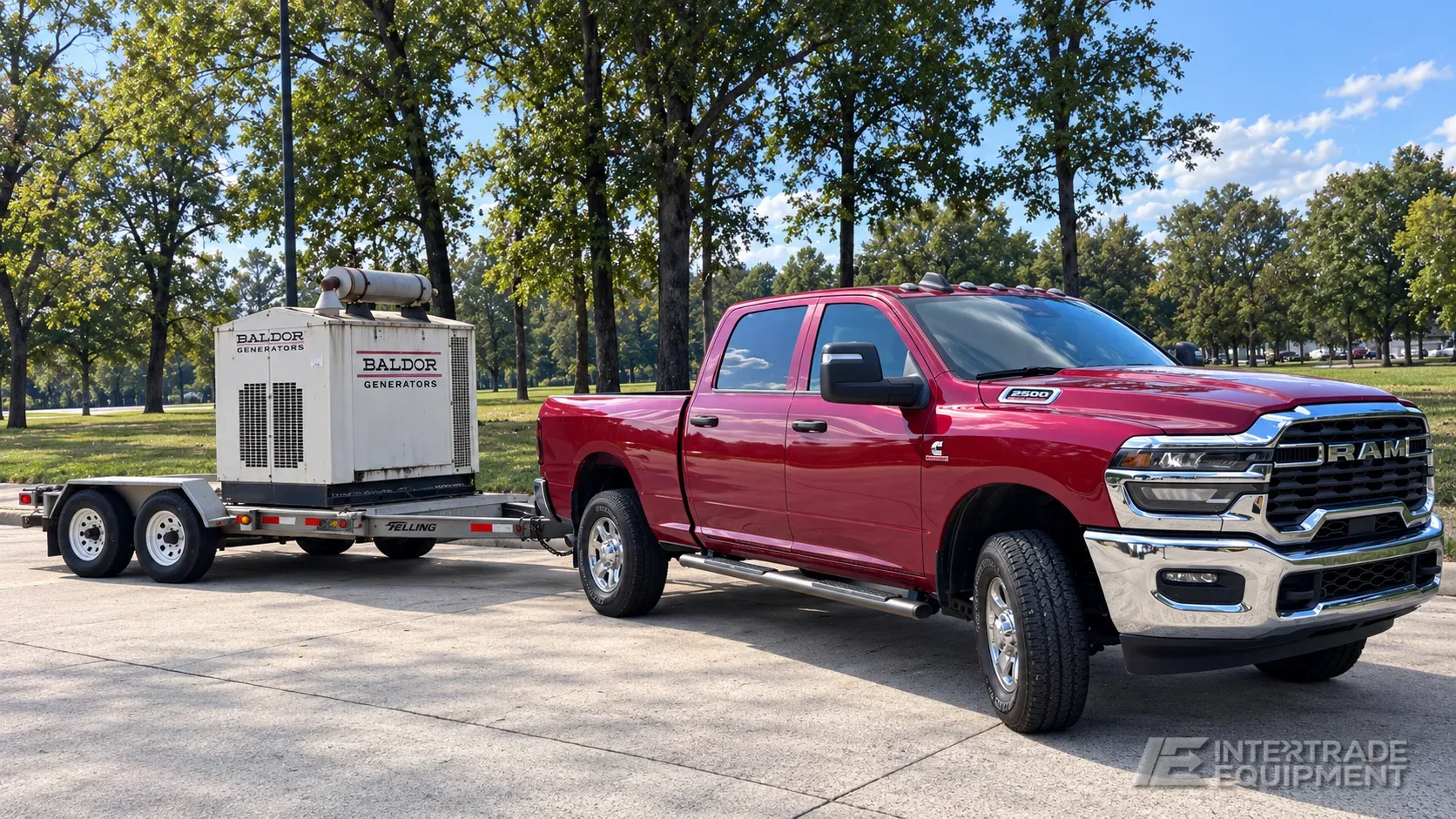
When a facility loses power, the generator is only one part of the answer. The equipment still has to start, accept the load, supply the correct voltage and keep running on the fuel available at the site. A machine that looks like a bargain in an auction listing can become expensive if any of those details are wrong.
Buying an industrial generator therefore starts with a specification, not a brand preference. A contractor seeking temporary jobsite power, a farm protecting ventilation systems and an overseas buyer sourcing backup equipment from the United States may need very different generator sets—even when their advertised kilowatt ratings are similar.
This guide explains diesel, natural gas and propane generators; standby, prime and continuous ratings; generator sizing; industry applications; international compatibility; and practical checks before buying used equipment. It also follows the purchase beyond the sales price, through inspection, loading, domestic transport and international shipping.
What Is an Industrial Generator?
An engine-driven generator set, often called a genset, combines an engine with an alternator, controls, cooling and supporting systems to produce electricity. The complete package may include an enclosure, base fuel tank, circuit breaker, battery charger and remote monitoring equipment. These items must be verified individually when evaluating a used unit.
The terms industrial generator and commercial generator do not define one universal size threshold. Both are used for equipment supplying businesses, facilities and productive operations. A relatively small commercial standby generator may protect selected building loads, while a much larger system may support a production plant.
For a buyer, the useful description is specific: required kW and kVA, voltage, phase, frequency, fuel, duty rating, operating environment and included equipment. “Industrial grade” alone answers none of those questions.
Industrial Generator Types: Compare the Fuel and the Package
Diesel Generators
A diesel generator is a candidate where onsite fuel storage and an established delivery plan suit the installation. Mobile diesel generators are also worth evaluating for temporary power and projects without a utility connection. Check the tank arrangement, usable fuel supply, service access and applicable emissions documentation.
Do not estimate runtime from the advertised tank capacity alone. Obtain the model’s fuel-consumption data at the expected load and account for usable capacity, replenishment and reserve requirements. A full tank is not a complete fuel-management plan.
Natural Gas Generators
A natural gas generator can suit a site with a suitable gas service, but the fuel connection must deliver the required flow and pressure under operating conditions. An existing gas line does not establish adequate supply for a new generator.
Before purchasing a used natural gas generator, give its fuel requirements to the installer and gas supplier. Confirm the meter, regulators, piping and pressure at load. A machine may run without an electrical load while an inadequate supply becomes apparent only when demand rises. Generac’s sizing guidance treats gas-pipe sizing as part of system design, rather than an afterthought.
Propane and LP Generators
A propane generator may be considered where pipeline natural gas is unavailable or onsite gaseous-fuel storage is preferred. Verify whether the engine requires propane vapor or liquid withdrawal and what the fuel system must deliver at the lowest expected temperature. Tank sizing is not simply a question of storing enough gallons.
Some generator models support both natural gas and propane, but fuel conversion is model-specific. It may involve approved fuel-system components, calibration and a different output rating. Do not assume that changing the hose converts a natural gas machine to LP. Caterpillar offers particular systems with automatic natural-gas-to-propane changeover; that feature should never be inferred for another generator.
Dual-Fuel, Bi-Fuel and Hybrid Systems
Ask what the seller means by “dual fuel.” A package that changes between natural gas and propane is different from a diesel engine using a controlled blend of gaseous fuel and diesel. Identify the approved fuels and operating modes from the actual documentation.
A hybrid power system can combine a generator with batteries, solar or other sources. Its value depends on load patterns and controls. Buying a conventional generator does not automatically provide battery charging, synchronization, grid interaction or microgrid capability.
Stationary, Skid-Mounted and Mobile Generator Sets
A skid-mounted generator may be suitable for lifting and transport without being a road-ready mobile generator. A trailer-mounted unit needs a separate assessment of the trailer, identification, tires, brakes, lights and towing requirements. A stationary package may require site-specific foundations, ventilation and exhaust arrangements.
Likewise, a weather enclosure and a sound-attenuated enclosure serve different purposes. Ask for acoustic information with its measurement distance and operating conditions. “Silent generator” is a search term, not a meaningful promise of zero noise.
Option | What to evaluate | Question before buying |
|---|---|---|
Diesel generator | Onsite storage, fuel quality, deliveries and engine condition | Can the site maintain the required fuel supply and operating schedule? |
Natural gas generator | Gas-service capacity, pressure, piping and interruption planning | Has fuel supply been checked at the required full-load demand? |
Propane generator | Approved fuel configuration, storage and delivery capacity | Does the complete fuel system support operation in local conditions? |
Mobile generator | Electrical configuration, trailer, connection points and transport | Is the package ready for the intended temporary-power work? |
Hybrid system | Generator, storage, controls and integration | Which functions are actually included and commissioned? |
Standby vs. Prime vs. Continuous Generator Ratings
The same generator family can carry different ratings for different duties. Comparing only the largest number in two advertisements can be misleading.
- Standby power: a rating associated with supplying backup power when the normal source is interrupted, subject to the manufacturer’s stated conditions.
- Prime power: a rating for an ongoing variable-load duty under the specified operating and maintenance conditions.
- Continuous power: a rating associated with supplying a substantially constant load over extended operation under stated conditions.
Manufacturers may distinguish additional categories, including emergency standby, mission-critical and data-center duties. Caterpillar explicitly notes differences between its ratings and ISO definitions. Obtain the exact rating sheet: annual usage, average loading, overload allowance, site conditions and maintenance requirements are not interchangeable across every product.
A used standby generator is not automatically suitable for daily off-grid production. Separately, a manufacturer’s duty rating does not establish whether local emissions rules permit the proposed operating pattern.
How to Size an Industrial Generator
Understand kW, kVA and Power Factor
Kilowatts, or kW, describe real electrical power. Kilovolt-amperes, or kVA, describe apparent power. Power factor expresses the relationship between them:
kW = kVA × power factor
For example, 70 kVA at a power factor of 0.8 corresponds to 56 kW. That calculation explains the relationship between the ratings; it does not establish the generator’s suitability for a particular group of motors or electronic loads. A load must remain within the applicable real-power, apparent-power and current limits.
Also distinguish kW from kWh. A generator’s kW rating describes power output, while kWh measures electrical energy produced over time.
List the Loads and Their Starting Requirements
Start with a load schedule. Record voltage, phase, running demand, motor-starting characteristics and the order in which equipment will connect. Pumps, compressors, refrigeration equipment and fans can make startup more demanding than steady operation. Generac’s mobile-generator guidance specifically calls for both starting and running requirements.
Do not apply one blanket motor-starting multiplier to the entire building. Starting method, motor characteristics and allowable voltage and frequency dip affect the result. Ask the designer to consider load sequencing and equipment such as soft starters or variable-frequency drives where appropriate.
Check Single-Phase and Three-Phase Requirements
A three-phase generator cannot be selected from total kilowatts alone when a site has substantial single-phase loads. Phase loading, alternator connections, neutral requirements and the manufacturer’s limits need review. Confirm the actual output configuration on the nameplate and wiring diagram.
A reconnectable alternator may offer several approved voltages. It does not follow that every voltage, phase arrangement or full output rating is available. Have a qualified generator specialist confirm what the specific alternator and controls support.
Account for Environment and Power Quality
High altitude, ambient temperature and airflow restrictions can affect usable output or cooling capability. An enclosure changes the cooling environment too. Caterpillar’s application guidance calls for equipment-specific evaluation rather than a universal derating percentage.
Sites with UPS equipment, drives and other nonlinear loads require attention to power quality and alternator performance. The practical request is not “add 20 percent to everything,” but “verify this generator against this load schedule and site.”
A Simple Planning Example
Suppose selected facility loads total 38 kW while running, and the purchasing budget allows a used generator advertised at 56 kW. There is not enough information to approve the purchase. The decision still depends on the machine’s duty rating, kVA, voltage, phase, starting loads, fuel and site conditions.
The next step is to send the load schedule and generator data sheet for a sizing review. Choosing a model first and asking the installer to make it work later reverses the process.
Which Industries Use Industrial Generators?
The same broad power-generation technologies serve many industries, but each application changes the specification. Use the following as a planning guide, not a substitute for an engineered load calculation.
Industry or facility | Loads to identify | Selection issue to resolve |
|---|---|---|
Construction and infrastructure | Temporary distribution, tools, pumps and site facilities | Changing loads, connections, mobility and working environment |
Manufacturing and workshops | Production machines, compressors, controls and ventilation | Motor starts, restart sequence and acceptable downtime |
Agriculture and irrigation | Pumps, livestock ventilation, lighting and storage systems | Seasonal demand, remote fuel supply and unattended operation |
Cold storage and food operations | Refrigeration, processing equipment and controls | Compressor starting and selection of essential loads |
Healthcare facilities | Project-defined essential electrical systems | System design, transfer requirements, testing and approvals |
Data centers and telecom | UPS systems, cooling, communications and network infrastructure | Power quality, transient response and redundancy architecture |
Water and wastewater utilities | Lift stations, pumps, treatment equipment and controls | Starting loads, automatic operation and environmental exposure |
Mining and remote industrial sites | Processing, pumping, support facilities and distribution | Prime duty, fuel logistics, altitude, dust and service access |
Hotels, retail and commercial buildings | Selected refrigeration, lighting, pumps and building services | Essential-load scope, noise, space and fuel arrangements |
Events and temporary facilities | Lighting, sound, catering and temporary services | Distribution, load changes, noise and transport readiness |
For agriculture, a generator for an irrigation pump is a different purchase from one protecting poultry-house ventilation. For manufacturing, keeping controls alive may require less capacity than restarting every production motor at once. Identify the operation that must continue before deciding how much equipment to support.
Critical facilities require a system-level assessment. A used hospital generator or a generator removed from a data center is not automatically certified or suitable for its next site. Transfer equipment, controls, redundancy, installation and maintenance arrangements matter alongside the engine-generator package.
Industrial Generators by Country: What International Buyers Should Check
Country names are useful when they identify an actual compatibility or procurement question. The examples below concern application planning; they are not a ranking of demand or a claim that one generator can be exported to every destination.
United States and Canada
Buyers planning a project in the United States or Canada generally begin with a 60 Hz requirement, then confirm the facility’s voltage, phase and installation standards. For a North Carolina business buying outside its region, inspection access, pickup conditions and domestic generator transport may be as important as finding a nearby seller.
Mexico, Brazil and Other 60 Hz Destinations
Mexico, Brazil, Colombia and the Dominican Republic are examples of 60 Hz markets. Matching frequency is useful, but it does not establish matching voltage, phase, certification or import eligibility. A used generator from the USA still needs a destination-specific technical and landed-cost review.
Ukraine, Poland and Other European Projects
Ukraine, Poland, Germany and the United Kingdom are examples of 50 Hz markets. For a buyer considering a U.S. generator for use in Ukraine or another European destination, frequency compatibility should be checked before bidding.
Ukraine’s energy-recovery needs are documented by the U.S. International Trade Administration. Even so, the purchase specification must distinguish occasional backup operation from frequent outages or daily generation. That distinction affects duty rating, fuel planning and service requirements.
Nigeria, Ghana, Kenya and South Africa
These are examples of 50 Hz destinations. The International Trade Administration identifies a generator market associated with unreliable grid supply in Nigeria. Buyers should establish the expected operating hours at the actual site rather than assuming that all projects in one country have the same duty cycle.
For a remote facility, ask who will service the engine and alternator, which parts can be obtained locally and how fuel will reach the site. Freight savings can disappear if an unusual controller or unavailable service component prevents commissioning.
United Arab Emirates, Qatar and Other Hot-Climate Projects
The United Arab Emirates and Qatar are also examples of 50 Hz markets. For projects exposed to high temperatures, evaluate cooling and engine capability at the actual site conditions. Include enclosure airflow, dust exposure and service access in the review.
The Caribbean and Mixed-Frequency Regions
Do not specify a generator for “the Caribbean” without naming the destination. Puerto Rico, the Bahamas and the Dominican Republic use 60 Hz, while Jamaica uses 50 Hz. Japan also has both 50 Hz and 60 Hz regions. Confirm the installation’s actual electrical requirements; national household reference tables do not define an industrial site’s service voltage.
Can a 60 Hz Generator Be Converted to 50 Hz?
Sometimes a manufacturer supports another configuration, but conversion must be verified for the complete generator set. In a conventional four-pole synchronous machine, 1,800 rpm corresponds to 60 Hz and 1,500 rpm to 50 Hz. This relationship is not a conversion procedure.
A change can affect available engine output, alternator voltage and rating, cooling, controls and protection. A transformer changes voltage, not frequency. Obtain written model-specific confirmation of the proposed configuration and resulting rating before budgeting or purchasing an export generator.
Which Generator Brands Should You Consider?
Brand is useful for finding documentation and service support, but inspect the complete package. Listings may identify the generator-set manufacturer, engine manufacturer and alternator manufacturer separately. An engine badge does not necessarily identify who built and rated the finished genset.
When comparing Cat, Cummins, Generac, Kohler-branded, MTU-branded, Baldor or other used equipment, request the actual model, serial numbers and manuals. Confirm service parts by those identifiers. For older equipment, availability of the controller, voltage regulator, governor components and wiring information can influence the purchase as much as engine familiarity.
Buying a Used Industrial Generator: Inspect More Than the Hour Meter
A used generator can be worth evaluating when its specification and condition fit the project. Low hours alone are not proof of readiness. Age, storage, maintenance, removal history and the completeness of the package all belong in the decision.
1. Verify Identity, Ratings and Included Components
Request clear photographs of the genset, engine and alternator nameplates. Record serial numbers, ratings, fuel, voltage, phase, frequency and speed. Compare the documents with the equipment presented.
Confirm whether the sale includes the enclosure, tank, breaker, charger, exhaust components, manuals and transfer switch. A generator advertised as “automatic” may support remote starting without including an automatic transfer switch.
2. Review Maintenance and Removal History
Ask why the generator was removed and when it last supplied a meaningful load. Request service invoices, exercise records and previous test reports where available. Compare reported hours with the controller and physical condition, while acknowledging that meter replacement or incomplete records may prevent verification.
3. Inspect the Engine, Cooling and Fuel Systems
A qualified inspector should assess leaks, corrosion, cooling components, mounts, belts, hoses, battery condition and visible fuel-system condition. Request a cold start when practical and observe operation after warm-up. Agree beforehand what can be tested at the seller’s location.
For an installed gas unit, a fuel supply may not be available after removal. For diesel equipment, tank condition and stored fuel deserve attention. An untested item should be priced and described as untested rather than assumed fully functional.
4. Evaluate the Alternator and Controls
The engine running smoothly does not prove that the alternator, voltage regulation or protective controls operate correctly. Ask a generator technician which electrical checks are appropriate for the machine. Insulation testing, where justified, requires proper isolation of electronics and a manufacturer-compatible procedure.
A controller showing “No Faults” reports its current alarm state. It does not replace a performance test or establish the remaining life of the equipment.
5. Request a Load-Bank Test Where Appropriate
A generator load-bank test applies a controlled electrical load and can reveal performance that an idle demonstration cannot. Cummins describes load-bank testing as a way to exercise a standby system under load while avoiding reliance on the facility’s critical loads.
Agree on the test scope: load level and type, duration, voltage, frequency, ambient conditions and data recorded. A basic resistive test does not reproduce every motor start, UPS interaction or transfer sequence at the destination. Review what the report demonstrates and what remains untested.
6. Put Inspection Limits in Writing
For a remote purchase, an equipment pre-purchase inspection can help document visible condition and available operating checks before commitment. Specialist electrical testing and load-bank testing should be explicitly requested and confirmed; they are not automatically included in a general mechanical inspection.
Buying a Generator at Auction or from a Private Seller
Before bidding, read the lot description, sale terms and removal requirements. Confirm buyer’s premium, applicable taxes, payment deadlines, pickup windows and loading assistance. Separate the statements “starts,” “runs” and “tested under load”; they describe different levels of evidence.
Build a maximum bid from the total project budget. Deduct inspection, removal, lifting, transport, immediate repairs and commissioning costs before deciding what the equipment itself is worth to you.
If the public listings do not match the specification, equipment sourcing can widen the search across auctions, dealers and private sellers. A generator sourcing request should describe the required output and duty rather than listing a brand alone.
Generator Transport in the USA and International Shipping
Domestic Generator Transport
A generator shipping quote needs dimensions and weight for the actual transport configuration. Include tanks, trailer, enclosure and loose accessories. Confirm whether the quoted weight includes fluids.
Explain pickup and delivery access, loading equipment, lifting arrangements and unloading responsibility. A skid-mounted generator may need a crane or appropriately rated forklift; available lifting points must be verified for the complete package.
Domestic equipment shipping should be planned around the cargo and site. A shipment may suit a flatbed, step-deck or another arrangement depending on dimensions, weight and handling needs. The lowest freight quote is not useful if loading or unloading is omitted.
International Generator Shipping from the United States
For international buyers, compare the complete route from seller to destination. Container shipping, flat-rack or other ocean-freight options depend on cargo dimensions, handling requirements and the available service. Air freight may be considered where feasible, but should be quoted against the actual package rather than assumed economical.
Before payment, establish the electrical configuration, import eligibility and responsibilities for documentation, customs clearance and destination charges. Carrier requirements for fuel, batteries, fluids and cargo preparation must be confirmed for the shipment.
International equipment shipping coordination can bring together inland transport, freight forwarding and required documentation. Availability and requirements remain specific to the equipment, buyer, destination and route. Obtain the destination broker’s confirmation before dispatch.
Calculate Total Landed Cost
Use a written budget covering purchase price, premium, applicable taxes, inspection, testing, removal, packing, inland freight, export handling, international freight, insurance, destination charges, duties or taxes where applicable, final delivery and commissioning.
A freight-only price is not a delivered-and-operational price. Keep the generator purchase, transport scope and installation scope clear so costs do not fall between suppliers.
Installation, Transfer Switches and Operating Requirements
An automatic transfer switch, or ATS, is part of the arrangement used to transfer a supported load between power sources. Its voltage, current rating, poles, controls and installation must match the system. Do not assume a used ATS included in a sale suits the destination building.
Electrical protection, grounding, neutral arrangements, fuel connections, ventilation and exhaust require qualified design and installation. North Carolina’s Department of Labor warns against connecting a generator directly to a building without properly installed transfer equipment because of the danger of backfeeding.
Combustion exhaust presents a carbon monoxide hazard. A weather enclosure is not permission to operate a package inside an unsuitable room. Indoor stationary installations require engineered provisions; portable units must not be operated inside enclosed or partly enclosed spaces.
In the United States, EPA requirements depend on factors including engine type, age, location and emergency versus non-emergency use. Buying used does not eliminate that review. Confirm applicable requirements with the responsible local professionals before installation.
Maintenance, Fuel Planning and Ownership Cost
Follow the manufacturer’s calendar-based and operating-hour maintenance requirements. Even a low-hour standby unit needs attention to batteries, fluids, hoses, cooling, fuel and controls. Confirm who will service the complete generator package after purchase.
Prolonged light-load operation can contribute to wet stacking in diesel equipment. Cummins explains that insufficient loading can prevent optimal operating temperature and affect performance. Select the right capacity and follow the manufacturer’s exercise and testing guidance rather than assuming bigger is always better.
For fuel planning, compare consumption at realistic load points. Estimate operating cost using fuel, service, wear parts and staffing assumptions, then document them. Unsupported claims such as “runs all day,” “maintenance-free” or “lowest fuel consumption” are poor substitutes for model-specific data.
Frequently Asked Questions About Industrial Generators
What size generator does my business need?
Prepare a load schedule with running demand, motor starts, voltage, phase and acceptable interruption. Have the specific generator checked against that schedule and site conditions.
Is a 70 kVA generator the same as a 70 kW generator?
No. At a power factor of 0.8, 70 kVA corresponds to 56 kW. Verify both ratings and the applicable limits for the actual machine and loads.
Can a standby generator run continuously?
Do not assume so. Check the manufacturer’s duty rating, loading conditions and maintenance requirements, along with whether the proposed use is permitted locally.
Is diesel better than natural gas or propane?
The right fuel depends on supply, storage, expected hours, operating conditions and the equipment available. Compare complete installed and operating costs for the site.
Can I buy a used U.S. generator for a 50 Hz country?
Yes, if its documented configuration meets the project requirements or a qualified specialist confirms an approved conversion. Do not assume a 60 Hz machine is compatible because its kilowatt rating is sufficient.
How many hours are too many for a used industrial generator?
There is no universal cutoff. Review hours alongside duty, age, service records, storage and test results. Low recorded hours can coexist with expensive age-related or electrical issues.
Does a load-bank test guarantee future reliability?
No. It documents performance under stated test conditions. It is useful evidence, but does not guarantee future operation or test every part of the destination installation.
Is a transfer switch included with a used generator?
Only if the sale specifically includes it. Identify the ATS separately and confirm compatibility before treating it as part of the project.
How do I get a generator shipping quote?
Provide pickup and delivery locations, dimensions, weight, loading and unloading details, and any trailer or accessory information. International requests should also identify the destination country and port if known.
Can INTERTRADE EQUIPMENT help find a generator outside its inventory?
Submit the specification through the equipment request form. Sourcing, inspection availability and shipping arrangements can then be discussed for the machine and location involved.
Source, Inspect and Ship the Right Generator
Start with the work the generator must perform. Confirm the electrical specification and duty, evaluate its condition, and budget for transport and commissioning before committing to a purchase.
INTERTRADE EQUIPMENT LLC is a U.S.-based equipment business serving domestic buyers and international customers purchasing on the U.S. market. We buy and sell used equipment, search auctions and seller networks, arrange pre-purchase inspections, and coordinate domestic and international shipping.
Browse available equipment, request generator sourcing, request an equipment inspection or request a generator shipping quote. Include the required kW or kVA, voltage, phase, frequency, fuel, duty, destination and budget. Generator-specific testing and other specialist services are subject to an agreed scope and availability.
Technical Sources
This guide draws on manufacturer application resources and public technical guidance. Use the documentation for the actual generator set and qualified local advice for final equipment selection, installation and import requirements.
- Caterpillar — Understanding Generator Set Ratings
- Generac — Basic Sizing for Mobile Generators
- Cummins Power Suite — Generator Sizing and Application Resources
- Cummins — Load Bank Performance Testing
- Caterpillar — Ambient Capability of Enclosed Generator Sets
- Schneider Electric — Country Frequency Reference
- International Trade Administration — Ukraine Energy Sector
- International Trade Administration — Nigeria Electricity and Power Systems
- U.S. EPA — Understanding Stationary Engine Rules
- North Carolina Department of Labor — Generator Safe Work Practices